
Use an OEM shelving packaging checklist to confirm that the carton contents, internal protection, artwork, labels, barcode, instructions and pallet arrangement all refer to the same approved product version.
A carton can carry the correct logo while the manual inside belongs to another model. Artwork approval alone will not reveal that mismatch. The approval record should identify what has been checked, the evidence used and any points still to resolve before printing or packing is released.
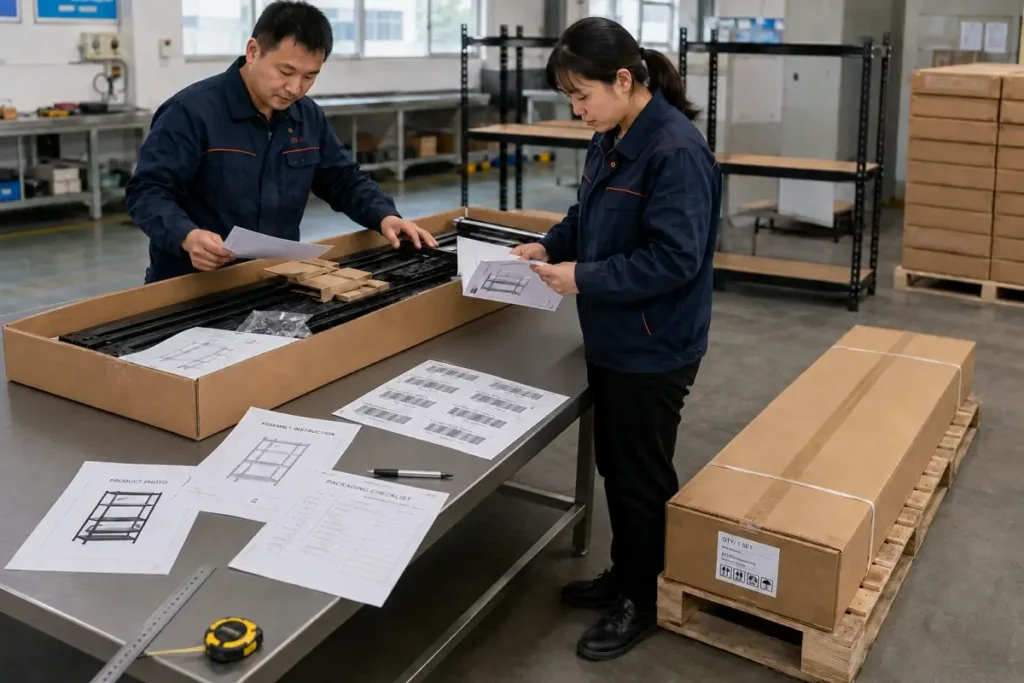
Match Carton Contents to the Approved Product
Before reviewing carton artwork, confirm exactly which shelving version is being packed. Record the model, drawing or specification revision and the component list for that version.
The list should cover the uprights, beams, shelf panels, supports, connectors and accessories actually supplied with the selected model. Quantities must match the approved product. Where spare parts are included, distinguish them from the standard assembly quantity.
Define what “one set” means. If a complete unit uses several cartons, identify the contents of each carton and how the cartons are numbered and kept together. If several units share one carton, record that quantity explicitly. This prevents a correct-looking carton from concealing an incomplete or mixed set.
For a foldable metal shelving unit with castors, match the castors and fixings in the carton to the approved parts list. Check any model-specific retaining clips against the selected configuration.
Review Carton Design and Internal Protection
Record the carton style, material specification, closure method and any agreed performance requirements. Measure external length × width × height in stated units with the intended contents packed and the carton closed. Keep product net weight separate from gross packed weight.
Check contact between components. Board panels can be rubbed by steel parts or damaged at exposed edges; coated components can also mark each other if they move. Depending on the configuration, protection may include separators, bags, edge protection, cardboard layers, bundling or defined component positions.
Review how the parts are restrained and how the carton is unpacked. Keep small accessories identifiable and secured so that they are not lost among larger components or discarded with packing material. An empty printed carton does not show whether these arrangements work with the product inside.
Check Labels, Barcodes and Shipping Marks
Match product identifiers to the approved model, size, finish and carton contents. Check the required SKU, quantity, carton number, weights, dimensions, shipping marks and destination-specific text where applicable. State which information belongs on a sales carton and which belongs on a pallet or shipment label.
Connect the product version, SKU or GTIN, barcode file and artwork revision in the approval record. Read the data from the final printed barcode and compare it with the intended identifier and human-readable text. Check its position on the closed carton and whether straps, folds or pallet wrapping obscure it.
A successful scan is not the same as formal barcode print-quality verification. Where a retailer or customer requires a verification grade, agree the applicable requirement and retain the report. GS1 explains how printed barcode quality is measured.
For common errors in carton numbering, printed weights and shipping marks, see the guide to shelving export carton labels.

Match Assembly Instructions to the Packed Model
The assembly manual is part of the product the customer receives. Compare it with the approved component list and assembled configuration, including the beam connections, shelf material, supports, connectors, feet and any supplied fixings or tools.
Confirm the parts quantities, assembly sequence, model reference, language and revision. Any dimensions or load statements printed in the manual should match the applicable product specification. A manual showing a different shelf panel or support arrangement needs review even if the cover carries the correct brand.
For several market or language versions, specify which file belongs to each SKU or order. File names such as “manual-final-new.pdf” do not identify that relationship clearly; use a model, language and revision reference.
Confirm Retail Artwork and Private-Label Files
Check that the carton image, shelf count, dimensions, finish and model description represent the approved product. A change from board panels to wire mesh, or a change in shelf levels, can leave earlier artwork inaccurate.
Approve the artwork on the agreed carton dieline, showing the printed size, label areas and barcode position. Keep the approved file revision identifiable. If artwork or a label carries a load claim, check its configuration and loading basis against the supporting product information.
Assign responsibility for preparing, checking and approving each file. The buyer may supply branding and identification data while the supplier prepares a dieline or packing arrangement, but the division should be agreed for the order. Identify who will verify required market wording; a general artwork sign-off should not be treated as confirmation of every destination requirement.
Review Pallet Packing and Loading Requirements
Not every order requires pallets. Where they are used, confirm the pallet type, cartons per pallet, stacking arrangement, loaded dimensions, gross loaded weight, securing method and label position.
Review the arrangement using the final packed cartons. Check whether receiving and handling limits have been provided, and whether required labels remain visible after wrapping or strapping. Pallet packing for bulk handling does not by itself establish that an individual carton is suitable for later parcel delivery.
Container planning should use final external carton or loaded-pallet dimensions. Changes to protection, carton construction or palletisation can alter shipment weight and space use, so update the loading basis when the packing changes.
Approve the Actual Packed Sample
Where practical, review a sample packed with the intended product, protection, accessory bag, manual, labels and closure. Reconcile the contents with the component list, inspect contact points and check the unpacking arrangement.
Look for moving components, exposed panel edges, trapped accessories, a bulging carton, damaged documents or labels hidden by the final packing. Record external dimensions and gross weight, and link photographs or measurements to the sample and packaging revision reviewed.
Define the scope of approval. A visual review can identify configuration and fit issues, but it does not establish transport performance. If testing is required for the route or sales channel, agree the method, packed configuration, acceptance criteria and evidence separately. A material or protection change may require that evidence to be reviewed again.

Record carton dimensions separately from assembled shelving dimensions.
Complete the OEM Shelving Packaging Approval Record
Use the checklist below to collect the approval evidence. In your working copy, record the responsible reviewer, date, status and reference file for each applicable item. Use “pending”, “revision required” or “not applicable” where appropriate; do not prefill every item as approved.
| Approval Item | Evidence to Record |
|---|---|
| Product version | Model, specification or drawing revision, and the component list used for packing. |
| Carton contents | Units or parts per carton, multi-carton identification, accessory contents and separate spare quantities. |
| Internal protection | Approved arrangement, separators, edge protection, restraint and reference photographs. |
| Carton construction | Style, material specification, closure, external L × W × H and units of measurement. |
| Weights | Product net weight and gross packed weight, with the carton or set basis clearly identified. |
| Artwork | Approved dieline and artwork revision matching the product image, description and configuration. |
| Labels and shipping marks | Approved wording, data and placement on cartons and pallets, as applicable. |
| Barcode | Intended identifier, printed-file revision, decoded-data check and verification report if required. |
| Assembly manual | Model, parts list, language and revision matching the packed configuration. |
| Pallet and loading basis | Required or not required; final arrangement, cartons per pallet, loaded dimensions, weight and securing. |
| Packed sample and tests | Sample reference, review scope, measurements, photographs and agreed test results where required. |
| Final release | Approved packaging revision, approvers, date and resolution of relevant open points. |
Record Revisions Before Production
If a panel, support, accessory or protection method changes, review the affected contents list, manual, carton size, weight, artwork and loading data. Update the relevant files and obtain acceptance of the changes before releasing the affected printing or packing.
Keep superseded files identifiable and make the approved revision available to purchasing, packing and quality-control teams. An approval date or file name alone is not enough if it does not identify the product and packing arrangement covered.
Frequently Asked Questions
Can packaging be approved from photographs?
Photographs can support a remote review of contents, arrangement, artwork and label position. Agree the evidence and approval scope in advance. Photographs do not replace measurements, checks of hidden contents or any required transport or print-quality testing.
Do all shelving orders need pallet packing?
No. The decision depends on the handling route, receiving requirements, carton configuration and shipment arrangement. Record pallet packing as required or not required for the order.
Can carton dimensions change after a product sample is approved?
Yes, if the product configuration or packing method changes. Reconfirm the external carton dimensions, packed weight and loading basis, and obtain approval of the affected packaging revision.
Approve the Packaging as One Product Version
The final approval should identify one product version and the packing evidence that belongs to it. Resolve relevant open points before releasing printing or packing, and review any later substitution against that approval.
Send QDDOWELL the product reference, quantity, destination and sales channel, together with the available packing specification, artwork and label files. Identify the items that still need review.