
Clear shelving specifications are the starting point for a useful quotation. A product photo or target price may show the general direction, but it does not define the dimensions, shelf layout, load basis, materials, packaging or delivery terms being priced.
The first enquiry does not need a completed engineering drawing. Send the available requirements in one current specification sheet, mark what still needs confirmation and identify which version should be quoted. Drawings and reference photos should support that document rather than replace it.

Start with the Storage Application
Begin by describing what will be stored and where the shelving will be installed. Cartons in a warehouse, tools in a workshop, stock in a retail backroom and household storage products may require different dimensions, shelf spacing and finishes.
A short description of the stored items, their approximate size and weight, and the available installation space gives useful context. Mention storage conditions and any access restrictions that could affect the choice of shelving.
When an existing product is being replaced or compared, include a clear reference photo or model number. State which details must remain the same and which can be adjusted. Buyers can review QDDOWELL’s storage shelving models to identify the closest product reference.
Use One Current Specification Sheet
Keep the product, packing and delivery requirements in one dated file. When a dimension, material, colour or packing instruction changes, update that file and its revision number instead of sending an isolated correction in another message.
Copyable Shelving Enquiry Template
Copy the following table into your enquiry and replace the prompts with your information. Use a separate model reference where sizes or configurations differ. Mark unknown details as “supplier to propose” rather than guessing a technical specification.
| Enquiry Field | Information to Enter |
|---|---|
| Application and product reference | Stored goods, storage environment, model or reference photo, and required changes. |
| Overall dimensions | Width × depth × height in mm, stating whether these are external or usable dimensions. |
| Shelf layout | Number of shelf levels, required clear spacing and any connected-bay layout. |
| Loading and stored items | Required load per shelf, load distribution, heaviest item weight and footprint; whole-unit requirement if applicable. |
| Materials and finish | Shelf material and thickness if known, finish by component and preferred colour reference. |
| Quantity | Units or bays by model and finish, and whether the request is for a sample or a bulk order. |
| Packing and branding | Carton contents, pallet needs, delivery route, labels, barcodes and manual requirements where applicable. |
| Destination and delivery basis | Country, port or delivery address; requested trade term, named place or port and edition if agreed. |
| Reference files and revision | Drawing and photo filenames, specification revision and date, and which earlier files are superseded. |
| Open points and alternatives | Details still to be confirmed, mandatory requirements and items for which a supplier proposal is acceptable. |
Separate mandatory requirements from preferences. If the supplier proposes a different panel, size or packing method, ask for the alternative to be identified separately so that the quotation does not silently replace the original request.
Confirm Dimensions and Shelf Layout
Provide dimensions in one unit of measurement and label their order. For example, use width × depth × height in millimetres throughout the specification. Do not rely on an unlabelled three-number size.
Distinguish overall unit dimensions from usable shelf dimensions. State the number of shelf levels separately from the overall height, and give the required clear spacing where the stored cartons or bins have a fixed height.
Check installation restrictions before confirming the dimensions. Doors, columns, skirting boards, ceiling clearance and aisle width may reduce the usable space even when the shelving fits the measured wall area. For connected bays, attach a layout identifying Starter and Add-On bays where applicable.
Describe the Load Requirement Clearly
State the required load per shelf and explain how the goods will sit on it. A uniformly distributed load (UDL) is spread across the shelf surface. A compact item resting on a small area creates a different loading condition, so a UDL figure should not be treated as a concentrated-load rating.
Provide the approximate weight and footprint of the heaviest stored item. If a whole-unit capacity is also required, state it separately rather than assuming it is the per-shelf figure multiplied by the number of levels.
Load figures should be reviewed together with the shelf dimensions, material, supports and frame structure. If the required component thicknesses or profiles are not known, describe the use and ask for a proposed configuration and its stated load basis. A reference photograph cannot establish these specifications.
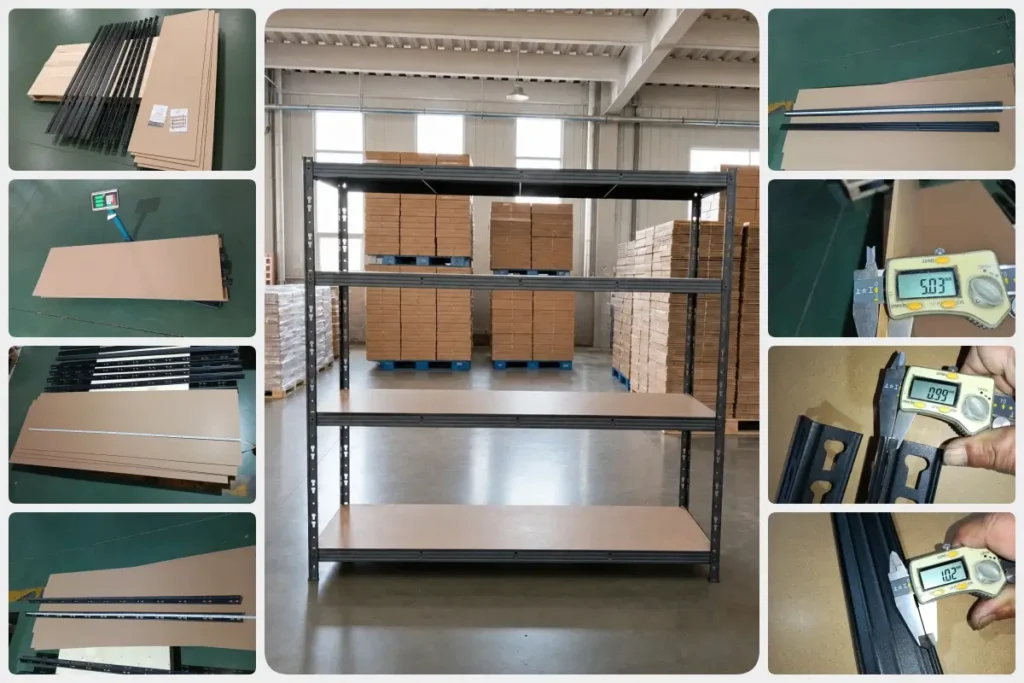
Add Materials, Finish and Packing Requirements
Identify the shelf material and thickness when these details are already known. MDF, steel panels and wire mesh are options on applicable models; availability and the supporting structure need confirmation. If a board panel is required, identify its material specification rather than using “wood shelf” as the only description.
For powder-coated components, provide the preferred colour and a reference where consistency matters. A colour code or sample reference is more useful than a colour name viewed on different screens. State which components require the finish, including any proposed galvanised parts.
Include carton, label, barcode, assembly instruction and pallet requirements at the enquiry stage where they apply. Cartons and pallets are not mutually exclusive: a unit may be packed in a sales carton and then palletised for bulk handling. Explain whether it will later be dispatched individually.
If the packing method is undecided, describe the sales channel and handling route and ask the supplier to propose it. Adding packing requirements after pricing may change the quotation, carton dimensions and loading volume. For a custom or private label order, see the guide to OEM shelving specifications and approval.
State Quantity, Destination and Trade Term
Provide the estimated quantity for each model and finish. Make clear whether a quantity means complete units, connected bays or cartons. Identify sample requests separately from bulk-order quantities.
State the destination country and, when available, the port or complete delivery address. If freight is required but the address is not final, identify the missing information and ask whether any transport allowance is provisional.
State the requested trade term, named place or port and applicable edition where agreed. The ICC Incoterms® rules explain how delivery tasks, costs and risks are allocated. If the delivery basis is not yet decided, describe the required destination and ask the supplier to state the basis used in the quotation.

Send Files the Supplier Can Check
Use files that allow the supplier to read dimensions and compare revisions. A clear PDF drawing, spreadsheet or high-resolution reference photo is more useful than several cropped screenshots with missing measurements.
Mark requested changes directly on the drawing or photo. Identify which dimension should change, which finish is preferred or where a label should be positioned. Where appearance is only a reference, say so rather than implying that every visible detail has been specified.
Use editable files for logos, carton artwork and instruction documents when available. Give revised files a clear name and version date, and identify which earlier documents they replace. You can flag files that are not ready yet; completed carton artwork is not required simply to open a product discussion.
Common Details That Delay a Quotation
Missing or conflicting information can lead to another round of questions. Before sending the enquiry, compare the dimensions on the drawing with the specification sheet, check whether load figures refer to each shelf or the whole unit, and confirm that quantities use the same unit throughout.
If a detail is unresolved, keep it visible. “Supplier to propose shelf material for the stated load and use” is more useful than choosing a material without a basis. Ask for proposed configurations, assumptions and excluded items to be stated in the offer.
A preliminary quotation may need revision when the configuration, packing or freight details are confirmed. The enquiry specification records what is being priced; it does not replace final drawing approval or verification of the selected configuration before production.
Send Your Shelving Specifications
Send QDDOWELL the completed enquiry template and the current reference files. If some information is unavailable, identify the open points and the details for which a proposal is needed.
This gives the review a clear starting point: the product configuration to be considered, the packing and delivery scope to be priced, and the questions still to resolve.